The Senj–Karlobag Road
Improving the transport connection between Karlobag, Senj and the wider coastal region.


1820–1904 · General of Infantry, military engineer and a driving force behind the renewal of the Velebit coastal region
NOTABLE PERSONS · KARLOBAG
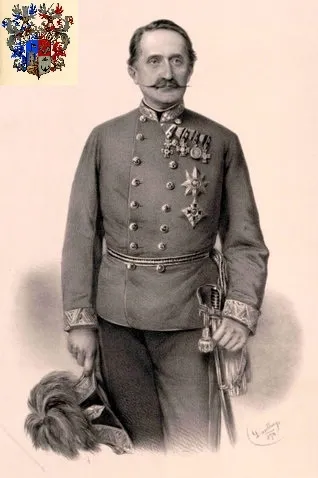
General of Infantry, military engineer and one of the key figures behind Karlobag’s development in the 19th century.
A military career, engineering work and a lasting contribution to the development of the town.
Anton Mollinary, whose full name was Anton Freiherr Mollinary von Monte Pastello, was born in Titel in 1820. He was the son of Karl Mollinary (1792–1868), a lieutenant colonel in the Tschaikisten Border Battalion in Titel, and Josephine Edle Mollinary von Monte Pastello (Hohensinner von Lanzenfeld und Camponero). Determined to pursue a military career, Anton Mollinary entered the Imperial and Royal Pioneer School at the monastery barracks in Tulln an der Donau as a cadet in 1833. He graduated as a lieutenant in 1837 and was assigned to the 45th Galician Infantry Regiment. Two years later, he was transferred to the headquarters of the Pioneer Corps in Vienna, where he reported to Lieutenant Colonel Karl von Birago.
Throughout his career, Mollinary distinguished himself as an accomplished engineer and became known for his work on the development of maritime infrastructure along the eastern Adriatic coast, including the Karlobag area. During the 19th century, he made an important contribution to road and harbour infrastructure and to the planning of projects with both strategic and economic significance for the wider region. His service brought him numerous honours and distinctions, including elevation to the baronial rank (Freiherrenstand) on 9 July 1872, thereby entering the Austrian nobility. The title of baron was conferred upon Anton Mollinary by Emperor Franz Joseph I, the Austro-Hungarian monarch.
His technical work, together with his contribution to the organisation of maritime traffic, also left a lasting mark on the history of Karlobag, where his memory survives in old postcards and contemporary records. He was closely associated with projects that improved harbour infrastructure and the safety of navigation along the Adriatic coast.
The best-known elements of Anton Mollinary’s legacy in Karlobag include three major projects: the construction of the Senj–Karlobag road, the development of Karlobag’s waterfront and the construction of the primary school.
In recognition of his contribution, a monument dedicated to this distinguished general once stood in Karlobag’s main square, symbolising the gratitude of the local community for his role in the town’s development. Although the monument no longer survives, it remains clearly visible in historical postcards from the period.
Three of Mollinary’s best-known contributions to Karlobag, highlighted from the biographical record.
Improving the transport connection between Karlobag, Senj and the wider coastal region.
The development of harbour infrastructure and the waterfront as an important transport and economic space.
Investment in education as one of the foundations of the community’s long-term development.
A PRESENCE IN COLLECTIVE MEMORY
As an expression of gratitude to Anton Mollinary, his bust was erected in Karlobag’s main square. The story of its creation, ceremonial unveiling and eventual disappearance is now preserved as a separate chapter in the museum collection.
Explore the story of General Anton Mollinary’s bust