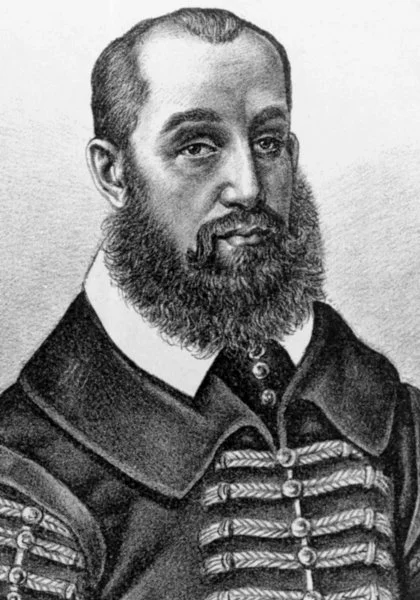
Marko Mesić (c. 1640 – 2 February 1713) was a Croatian priest, military chaplain and one of the most important organisers of resistance to the Ottomans in Lika and Krbava in the late 17th century. Born into a noble family in Brinje, he spent his childhood there and received his basic education. From an early age, his life was closely connected with the Church and with the frontier world shaped by the constant Ottoman threat, which strongly influenced his later work.
He was ordained a priest in 1664 and subsequently began serving as parish priest in Brinje. In recognition of his exceptional commitment and standing, he was appointed a canon of Senj in 1678. Even by then, he was known for frequent journeys into territories under Ottoman rule, where he ministered among the local Christian population, activities for which he was required to provide explanations to the Church authorities in Rome. In 1676, the Pope granted him special permission to serve as a military chaplain.
During the Great Turkish War (1683–1699), Mesić played a key role in organising Croatian frontier units that took part in uprisings and battles for the liberation of Lika and Krbava. Working with the Karlovac general Ivan Fridrik Josip Herberstein, he participated in the liberation of these regions in 1689. On the ruins of the old Cathedral of St James in Krbava, he celebrated a Mass of thanksgiving, the first there since the Battle of Krbava Field in 1493.
After the liberation, he exerted considerable influence on the administration, judiciary and ecclesiastical renewal of Lika and Krbava, and became the first Archdeacon of Lika and Krbava. He worked to resettle depopulated areas, distributed land to Catholic and Orthodox settlers, and took part in rebuilding the Roman Catholic Church. In recognition of his service, Emperor Leopold I granted him the village of Mušaluk in 1693. He died in Karlobag, where, according to the most reliable research, he was also buried.