Noble of Ražanac Jerko Rukavina Vidovgradski of Ražanac was a prominent member of one of the most notable Lika families and one of the first Croatian officers in the service of the Habsburg Monarchy in the 17th century. His life path, marked by military discipline and patriotism, is deeply connected with the history of the Military Frontier.
According to some accounts born in Ražanac, Jerko began the long tradition of military service in the Rukavina family. From an early age, he chose a military career that led him through various assignments in the fight against the Ottomans.
His exceptional courage, strategic insight, and dedication to service ensured his rapid rise. Although his career was tied to the imperial army, Jerko Rukavina never forgot his Croatian roots.
Jerko Rukavina symbolized the blend of Lika tradition, frontier discipline, and noble status earned through battle and merit. His name remains inscribed in Croatian military and noble history as an example of a successful officer who proudly bore the surname of his homeland.
Why is Jerko Rukavina important for Karlobag?
Throughout centuries of Ottoman incursions and wars, Karlobag (formerly Bag) was repeatedly destroyed and abandoned. During the Great Turkish War, the Ražanac noble Jerko Rukavina, together with the Vinjerac noble Dujmo Kovačević, led Croats from the Bunjevci group to Bag (today’s Karlobag) in 1683. A few years later, in 1686, they led their Bunjevci to Lika. The route they took was via the Baška Gate pass, settling in four villages: Brušane, Trnovac, Smiljan, and Bužim.
Although the liberation of Lika and the coastal region was not the achievement of a single individual but rather the result of the combined efforts of the Habsburg army and local commanders, Rukavina stands out as one of those who organized the arrival of new families, particularly Bunjevac groups, and contributed to the defense and stabilization of the area. His actions supported the restoration of local communities after the retreat of the Ottomans.
Thanks to such efforts, Karlobag entered a new period of development in the late 17th century, and the Rukavina family maintained its prominence and presence in the region. In the collective memory of the Velebit foothills, Jerko Rukavina remains remembered as one of the notable figures of his time, associated with the restoration of life in this part of the Croatian coast.
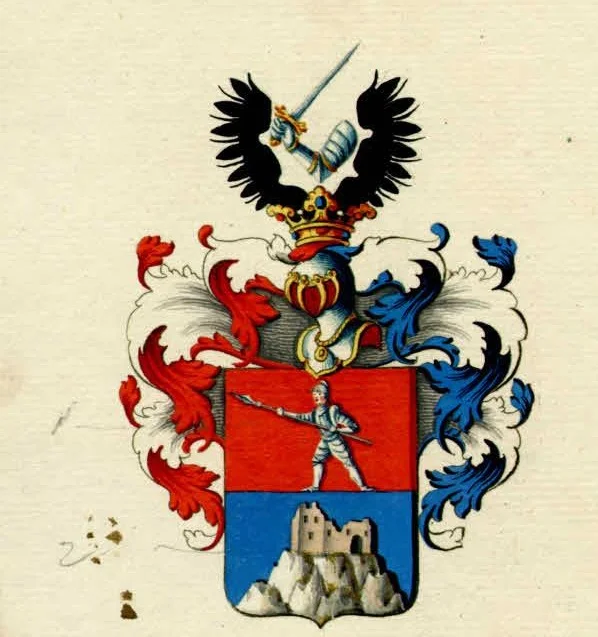
Members of this noble family carried various epithets, such as "Vidovgradski," "von Vezinovac," "od Klanaškog polja," "Bojnogradski," "Ljubački," or "von Liebstadt" and "von Morgenstern." Most officers and nobles bore the epithet "Vidovgradski," which was named after the old fortress Vidovgrad above Karlobag. The first commander of this fortress was Jerko Rukavina, who brought the Bunjevci to Karlobag, from where they later settled in Lika and the Croatian coast.
Jerko Rukavina had two sons, Nikola and Dujam.
Nikola Rukavina "Vidovgradski," whose year of birth is unknown, passed away in Trnovac in 1736. He served as the commander of Smiljan, Trnovac, and Podgorje. Nikola distinguished himself in battles against the Turks, and in a duel, he killed the renowned Turkish megdan fighter Šaban Razić, the dizdar (castle commander) of Bilaj Grad, present-day Bilaj in Lika.
Dujam Rukavina "Vidovgradski," whose year of birth is also unknown, died in Karlobag in 1729. He held the position of chief judge in Karlobag, where he spent the final years of his life.
From the two brothers, Nikola and Dujam, who together had twelve children, all the Rukavina family in Trnovac descends. Among their descendants were three generals in the Austrian army and three Austrian and Hungarian barons.
Today, as visitors walk through Karlobag, history reminds us that the town’s identity was shaped by individuals like him — people who, in difficult times, helped rebuild the community and lay the foundations for its future growth.